Enclosed duel field (lists)
The Last DuelThe Enclosed duel field (lists) was the bounded arena at Saint-Martin’s dueling ground where the judicial combat between Jean de Carrouges and Jacques Le Gris took place. Its walls, guarded entrances, officials’ towers, segregated viewing stands, and strict rules turned a violent contest into a closely supervised public ceremony: spectators could witness the combat, but were not permitted to interfere with it.
Site and Physical Arrangement
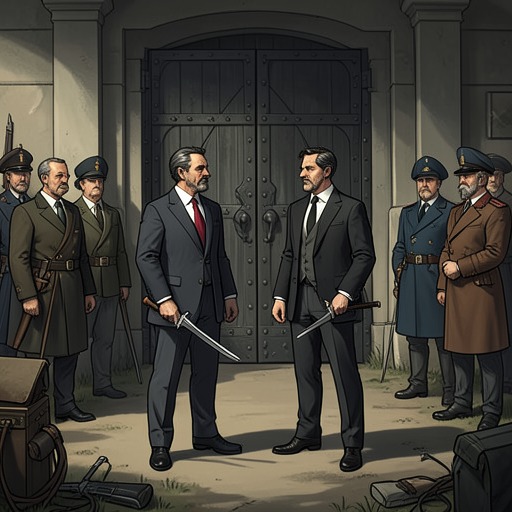
The field stood at the Priory of Saint-Martin-des-Champs. Accounts give differing measurements: one describes an area forty by eighty paces, another twenty-four by ninety-six. With a pace reckoned at about two and a half feet, these estimates imply different proportions, and the surviving evidence does not settle the discrepancy. The arena was enclosed by a high inner fence and a second, lower outer wall, creating a boundary between the combatants and the surrounding crowd.
At each of the four corners, outside the inner wall, a wooden tower gave officials a close view and hearing of the action. The towers also allowed food and drink to be supplied to the combatants during the fight. The outer wall had two entrances closed by heavy sliding gates. Guards surrounded it during the combat, both to keep spectators from pressing against the inner fence and to suppress disturbances.
Audience and Viewing Stands
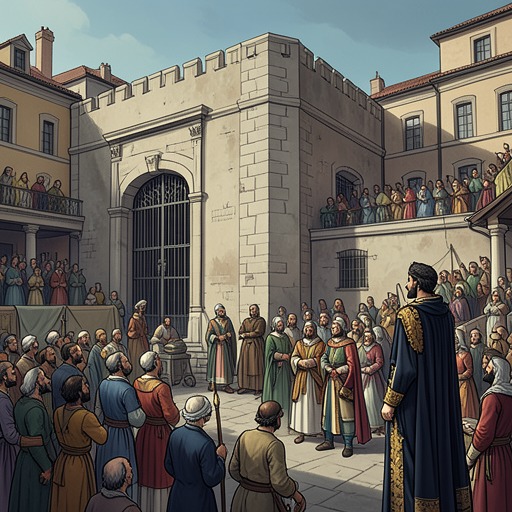
As the duel approached, the grounds were prepared for thousands of onlookers. Most were city residents and people from the suburbs, who would stand or sit on the ground around the field. Others came from distant parts of France or foreign courts, while nobles and members of the French royal court expected more privileged places from which to watch.
Large timber stands with railings, stairways, and seats lined one side of the field. The central stand, slightly advanced from the others, was reserved for the king, his uncles, and other high-ranking nobles. Another accommodated members of the king’s court; a third, to the left, seated foreign nobles according to rank. These stands were reserved for men of the nobility, including church prelates such as the bishop of Paris. Separate stands for women stood to either side and were designed to let their occupants withdraw if fatigue or the violence of the spectacle became too much. Below these ranks, stands were assigned to burghers and merchants; most commoners watched from the ground, looking through gaps in the tall timber fencing.
Ceremonial Use and Control
The field’s boundaries organized more than the fight itself. They regulated who could approach, who could watch from a particular position, and how the audience was to behave. Before the combat began, a herald publicly proclaimed the king’s rules: unauthorized weapons were forbidden, spectators had to remain seated so they would not obstruct others, and anyone who spoke, gestured, or otherwise made a disturbance during the battle faced severe penalties. Even remaining on horseback was restricted, with different penalties specified for nobles and servants.
The combatants’ equipment was examined on the field to ensure that no prohibited device had been brought in and that their lances, swords, axes, and daggers were equal in length. The demand for formal equality extended to rank: because Jean de Carrouges was a knight and Jacques Le Gris a squire, Le Gris was knighted before the fight. The arrangements made the arena a place where procedure was staged in view of the crowd, with officials, heralds, guards, and combatants each assigned a part.
The Field as Public Spectacle
The arrival processions made the enclosure a stage before the fighting began. Jean de Carrouges entered first on a palfrey, accompanied by pledges, relatives, squires, and attendants bearing his equipment; his armored warhorse was led separately. He carried a blue-painted pole topped with a silver crucifix and repeatedly made the sign of the cross. His shield and embroidered coat displayed the Carrouges arms. Marguerite de Carrouges arrived in a black-draped carriage, accompanied by her father and cousin. The crowd’s attention shifted toward her, making her presence a central part of the public scene.
Marguerite watched from a scaffold of her own, covered in black and placed in clear view of the field. She had not been legally condemned, but if her husband died she faced execution. Her position and clothing therefore made the stakes visible to the spectators: the outcome of the combat would determine not only which man prevailed but whether she lived. The field’s carefully divided spaces exposed that unequal peril as part of the ceremony.
The audience was expected to watch in near-total silence; chroniclers describe spectators scarcely daring to breathe. When the combat ended, Jean de Carrouges turned toward the king’s stand, bowed, acknowledged the crowd, and asked, “Ai-je fait mon devoir?” The thousands who had been silent answered, “Oui! Oui!” Their shout carried beyond the monastery walls into the surrounding district and streets of Paris. The enclosure had held the crowd in enforced quiet until the duel’s conclusion, when collective acclamation made the victory audible beyond the field. In this way, the arena joined physical containment to public judgment: it could display the ritual outcome and its reception, even though the fight’s spectacle could not itself let spectators directly observe the truth of the original accusation.